-
311, Laxmideep Building, Nirman Vihar, New Delhi, India


Education Loan to Study Abroad: A Complete Guide for Indian Students
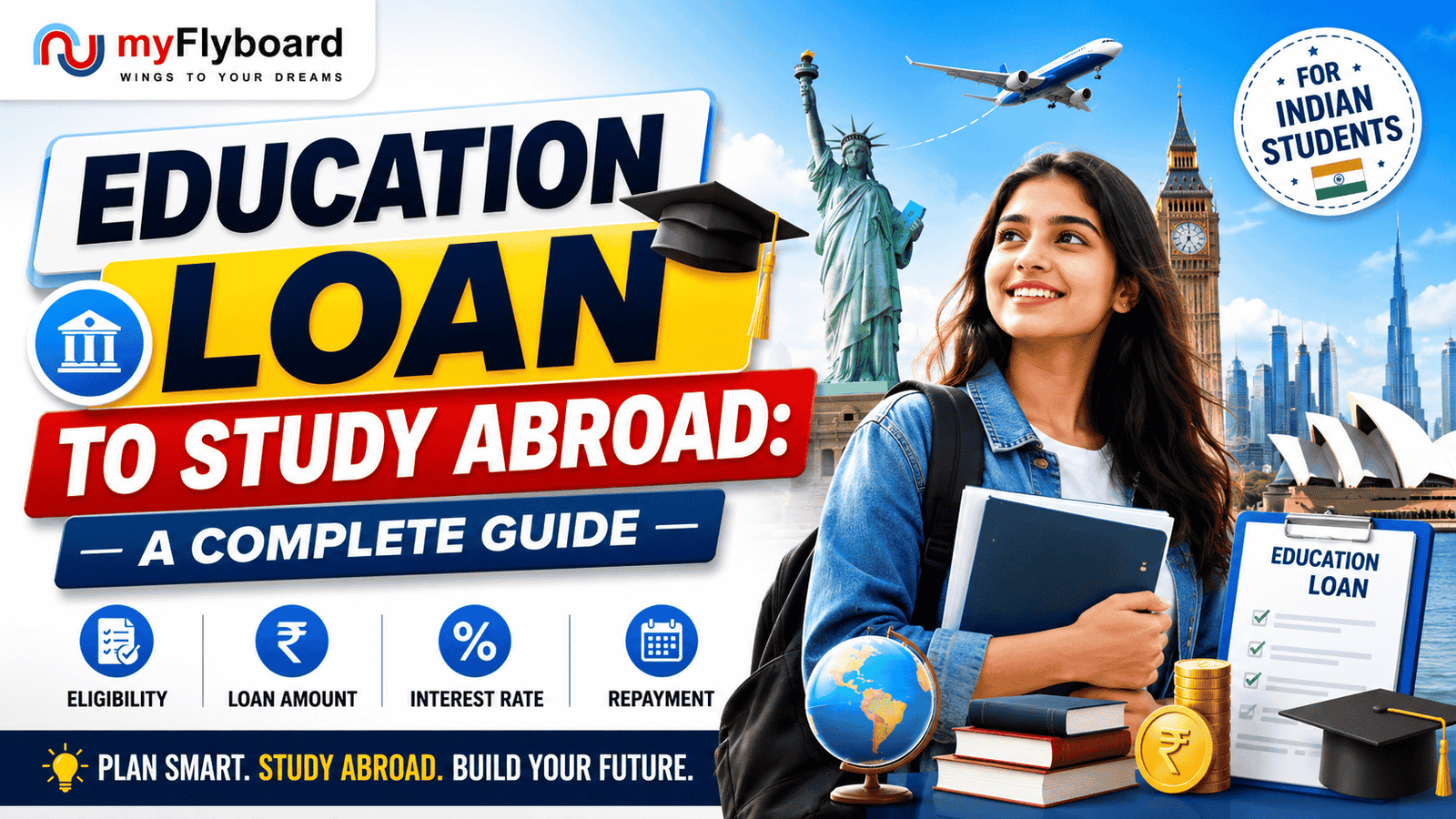
Going to study abroad is one of the most significant
investments that a student and family will make. Depending on the country and
the course, the total cost of an overseas degree can be anywhere between ₹15
Lakhs and ₹60 Lakhs, which includes the tuition fee, travel, accommodation, and
daily living expenses. However, for most Indian families, savings are
insufficient to be able to cover this, so that's why an education loan to study
abroad has become so popular. The following is a rundown of all the things you
should know before applying.
Why Take an Education Loan for
Studying Abroad?
An education loan is more than a simple financial solution. It allows you to join a dream college without putting your entire family savings, and makes payments over several years affordable in terms of EMIs, and — with Section 80E of the Income Tax Act — the interest you pay is completely tax deductible for up to 8 years. Many lenders will also fund your total cost of attendance, which encompasses tuition, travel, accommodation and even laptop if necessary, and you won't have to get funding from multiple sources.
Types of Education Loans Available
1. Secured Education Loans: These
loans involve collateral like property, fixed deposits, or other assets.
Secured loans are typically offered with a lower interest rate and greater loan
amount because the lender's risk is low — sometimes it can be the entire amount
of the course. Most nationalized banks provide secured loans of max. ₹1.5 crore
or maximum as per their norms, normally the banks require the borrower to
provide the required collateral above ₹7.5 lakhs under the IBA model scheme.
2. Unsecured Education Loans: No
collateral is needed, but eligibility depends heavily on the co-applicant's
income and credit profile. International lenders such as MPOWER Financing,
Prodigy Finance and NBFCs such as Avanse, HDFC Credila and more specialise in
unsecured or no cosigner loans, which can be useful if you do not have your
family's property to get a loan on or if you are enrolled in school and do not
have a strong financial co-applicant.
3. Government Education Loans: These
are the schemes available by the Government of India and various State
Governments for students from economically weaker sections or reserved
categories with interest subsidy. Some of the schemes include the Dr. Ambedkar
Central Sector Scheme for OBC/EBC students, the NBCFDC scheme for backward
classes (with a loan limit of ₹20 lakhs at 4% interest) and the state specific
schemes such as KGC scheme in Gujarat. Such schemes are usually reserved for
the families having an annual income of less than ₹6 lakhs.
Read More: Best Universities in the USA
Eligibility Criteria
Specifics can differ with each
lender, but most banks and NBFCs check the following:
• Passport: Must be valid in the name of
the applicant for at least three months.• Identity Card: Must be a valid
passport issued by the government and must have the name of the applicant on
the card for at least three months.
• Age: Generally 18–35 years
• Academic record: Cleared 12th Board or
Qualifying Degree with minimum 50-60% marks with no active backlogs.
• Admission status—Offer letter
confirming admission in a foreign university/college from a recognised
institution.
• Standardized test scores: Valid IELTS,
TOEFL, GRE, GMAT scores as needed by most lenders
Approval odds are enhanced by the
presence of another parent, guardian, sibling or spouse with a stable income
and good credit history.
Documents You'll Need
Having your documents organized makes the approval process quicker. Normally, lenders will require:
• Identity Proof: Passport, PAN card,
Aadhaar, Voter ID card
• Work documents: CERT documents or job
application forms including letter of recommendation, job application, or CV
• Financial documents: Last 2-3 years'
Income Tax Returns, Form 16, last 3-6 months' salary slips or bank statements,
and business proof if self-employed
• Collateral documents (for secured
loans): Property papers, FD receipts, or other asset proof
Read More: Best MBA Colleges in the World
How to Apply: Step by Step
1. Calculate your actual need. Calculate tuition + travel + room and board + insurance + living expenses – scholarships or personal savings.
2. Compare lenders. Identify 2-3
banks and/or NBFCs and check their interest rates, processing fee, moratorium
and loan coverage.
3. Check eligibility. Ensure that
you and your co-applicant have the necessary income, age, and academic
qualifications to meet the lender's requirements.
4. Gather documents. Make copies
of all of the above in scanned and/or hard copy.
5. Submit the application. Apply
online or offline or fill the Common Education Loan Application Form (CELAF)
through the government's Vidya Lakshmi Portal to apply for loans from multiple
banks.
6. Verification and sanction. The
lender checks your paperwork, might have a brief chat with you and provides a
sanction letter with the approved amount, interest rate and terms.
7. Disbursement. The funds are
given to the university or in payments as outlined in your loan agreement.
Interest Rates and Repayment
Education loan interest rates in
India are generally dependent on the lender's benchmark rate (such as Repo
Linked Lending Rate) and have a spread ranging from 8% to 13% for secured
loans, while unsecured loans from NBFCs may carry a higher interest rate. The
interest concession for female students is often 0.5% and the government scheme
loan has as low as 4%. It is not an immediate repayable amount.
Most loans have a moratorium period, which is the period of course after which
you have a grace period of 6 months to a year to complete your studies and get
placed before the EMIs kick in. Some lenders provide simple interest through
this time period or partial interest payments to help decrease your total
burden.
Tips to improve the chances of
approval:
• Submitting early is important —
preferably 3-6 months in advance, as processing may take weeks.
• Boot your co-applicant's profile by
getting their ITRs, salary slips and credit score sorted.
• Select a reputable university —
financial institutions are more inclined to finance studies at an acknowledged
university.
• Make sure you look at scholarships and
grants first and then try to lower the amount you need to borrow.
• Before signing, negotiate processing
fees and determine any hidden charges.
• Check at least three sources, both
banks and NBFCs, as rates may differ.
Final Thoughts
The key to making any study abroad
dream a reality is finding the right kind of education loan, which you may need
to have, depending on your financial resources, your desired university and
whether you have any collateral to offer. The first step is to clearly
understand the cost of the entire package, then to check the options from the
government, banks, and NBFCs and apply in advance of intake. Financing your
international education doesn't have to be as difficult as getting in, as long
as you have the right loan and a solid repayment plan.

Latest Post



-
Email Address:
info@myflyboard.com
-
Phone Number
+91 9818024841
-
Our Address
311, Laxmideep Building,
Nirman Vihar, New Delhi, India